

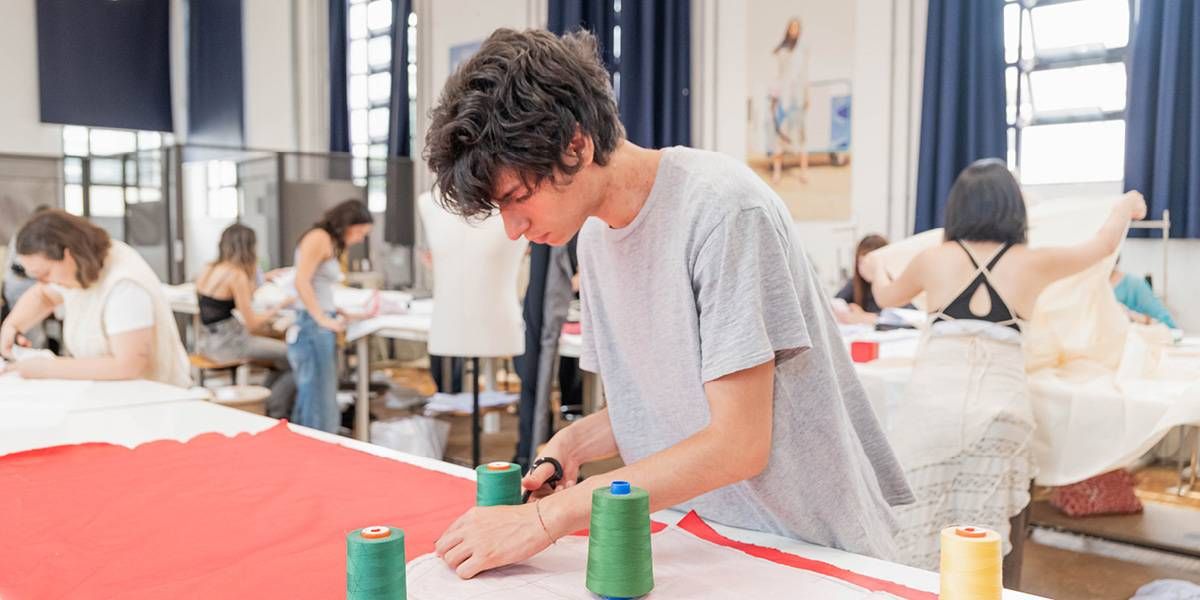
- Choosing a fashion course: clarify your goals
- Which fashion course should you choose? 5 useful questions to ask yourself
- How to choose the right fashion course: assess your aptitudes carefully
- Choosing the right fashion course: think carefully about your budget
- What to consider when assessing your budget
- How to tell whether a fashion course is truly right for you: read the curriculum carefully
- Analysing a fashion course curriculum: what to look for
- Accreditation and qualification recognition at the end of a fashion course
- Evaluating a fashion course: check who is on the faculty
- What makes a good fashion course: industry connections
- NABA fashion courses: discover the programmes offered by the Fashion Design Area
- How to choose among the NABA fashion courses in the Fashion Design Area
- Book an orientation interview
Understanding how to choose the right fashion course for you is the first real step towards turning an interest into a successful future career. When it comes to fashion education, passion alone is not enough, and neither is choosing a course at random: to invest in the right path, you first need to understand clearly what goals you want to achieve, how to make the most of your talent, what kind of career you want to build and what budget you have available for your studies. Choosing well means finding a course that connects your personal inclinations, the skills you need to develop and concrete professional opportunities.
Today, the fashion industry offers a wide range of career paths: from collection design to fashion marketing and communication, as well as roles focused specifically on the product, the materials from which it is made, or the business dimension of a fashion collection. This is why choosing the right fashion course requires careful analysis: you need to understand what is actually studied, which skills are developed, how to read a curriculum and what distinguishes a more creative path from a more strategic or more specialist one.
In this guide, you will find everything you need to make an informed choice: from the criteria to consider before deciding to a focus on the courses offered by NABA’s Fashion Design Area, so you can understand which programme may genuinely be the best fit for your profile.
Choosing a fashion course: clarify your goals
One of the most common mistakes? Choosing a fashion course without really asking yourself what job you want to do. Fashion is a complex system, made up of very different professional roles — and each educational pathway responds to different needs.
The main professional areas in the sector, and the roles within them, can be divided as follows:
- Design and creation: Fashion Designer, Textile Designer, Pattern Maker, Costume Designer and Accessory Designer.
- Communication and image: Fashion Stylist, Fashion Editor, Creative Director, Art Director.
- Business and marketing: Fashion Buyer, Brand Manager, Product Manager, Supply Chain Manager.
- Digital and media: Social Media Manager for fashion brands, Fashion Digital Marketer, Content Strategist.
Each of these professions requires different skills — and specific educational paths. For example, a Fashion Design course with a strong practical and studio-based component is ideal for those who want to design garments and build collections. A programme in Fashion Marketing Management, on the other hand, meets the needs of those who want to work on market analysis, brand strategies and distribution.
Which fashion course should you choose? 5 useful questions to ask yourself
To clarify your goals more effectively, you can ask yourself a few simple questions:
- Are you more interested in creating a product or in building a strategy around that product?
- Do you prefer visual and creative work, or analytical and organisational work?
- Do you imagine yourself in a technical, design-led, communication-based or managerial role?
- Are you looking for a broad education, or one already focused on a specific specialisation?
- Do you need a course that leads more directly into employment, or do you want to build a foundation for further study through a Master of Arts or an Academic Master?
They may seem like obvious questions, but they are exactly the ones that help you avoid confused choices.
How to choose the right fashion course: assess your aptitudes carefully
In fashion, talent can take many different forms. Some people have a strong visual sensitivity and immediately imagine shapes, colours and silhouettes; others work best when developing a concept; some have a more technical approach; some stand out in material research; some are drawn to building images, narratives and brand identities; others, instead, have a more strategic mind, able to read data, trends and market dynamics.
If you do not yet have a clear idea of which profession you want to pursue in the future and you want to choose the right fashion course, you need to understand which activities bring out your strongest results. Do you feel more at ease when drawing and designing? When turning ideas and references into moodboards and visual storytelling? When organising information and translating it into a strategy? Or when going into the technical details of a product, its materials or its feasibility? These are important differences, because they help you distinguish between a general interest in fashion and a genuine inclination towards a specific area of the sector.
This is precisely where the choice of course becomes clearer. Very often, people feel broadly “suited to fashion”, but their potential truly emerges only within a specific field: design, production, materials, communication or marketing. Identifying this direction is essential, because it directly affects the kind of path worth investing in.
Once you have clarified your goals and aptitudes, there is another criterion that has a very concrete impact on your choice: budget. Assessing it seriously means considering the overall sustainability of the programme and understanding what level of investment is truly consistent with the kind of fashion education you are looking for.
In the case of a fashion course, the cost does not consist only of tuition fees. You also need to consider expenses linked to materials, software, work tools, living in cities such as Milan, possible relocation and so on.
For this reason, when comparing different options, the right question is not simply “how much does it cost?”, but rather: what kind of educational value does it offer in relation to the investment required? A course may have a higher cost, but prove stronger because it provides laboratories equipped with the latest technologies, allows students to work on real projects with leading companies, entrusts teaching to recognised professionals in the field and is built around a curriculum in constant dialogue with the world of work. At the same time, in the overall assessment it is important to consider whether the institution also offers scholarships, financial aid or other forms of support.
The budget for a fashion course should therefore not be considered only as an immediate expense, but as part of a broader evaluation that includes the quality of the education, personal sustainability and the concrete opportunities offered by the institution.
What to consider when assessing your budget
To avoid a superficial assessment, it is worth considering several factors:
- Tuition fees and additional costs, including materials, tools and living expenses.
- The possibility of scholarships or financial aid, which can make a course more accessible and sustainable.
- The duration of the programme, because Bachelor of Arts programmes, Master of Arts programmes and Academic Masters respond to different needs and levels of investment.
- The type of learning experience, meaning how practical, project-based and connected to the industry the course is.
- Opportunities for further growth, for example whether the programme can provide a solid basis for a future specialisation.
- Consistency with your professional goals, because an investment only makes sense if it takes you in the right direction.
How to tell whether a fashion course is truly right for you: read the curriculum carefully
The next step is to look closely at the curriculum and structure of the fashion courses you have selected. Many students stop at the general description, but to understand whether a programme is truly right for your profile you need to read the curriculum carefully.
This is where the difference becomes visible between a programme focused mainly on design, one that centres on marketing and management, one that explores experimentation with materials or one that prepares students for a more specific role. Reading the names of the subjects is not enough: you need to understand how they are organised, how they connect with one another and how much space is given to practical work. In fashion, this aspect is decisive, because the quality of an education is also measured by its ability to turn study, research and references into practical skills that can be used immediately in the market.
Analysing a fashion course curriculum: what to look for
When analysing a curriculum, pay particular attention to:
- The core subjects, to identify which skills are truly placed at the centre of the programme.
- The importance given to laboratories, workshops and projects, to understand how practice-oriented the course is.
- The balance between theory and practice, which is essential to understand whether the fashion education will be more theoretical, more applied or well balanced.
- The progression of the programme, meaning the way in which the course moves from the basics to the development of more advanced skills.
- The professional profile it appears to shape, by observing the type of activities, exercises and outcomes required.
Accreditation and qualification recognition at the end of a fashion course
One of the most underestimated aspects when choosing a fashion course is the nature of the qualification awarded at the end of the programme. Not all diplomas are equivalent, and the difference may affect their value in Italy and abroad, as well as their credibility in the eyes of companies.
The AFAM system: what it means and why it matters
In Italy, Academies that are part of the AFAM system, Higher Artistic, Musical and Choreographic Education, such as NABA, award qualifications recognised by the Italian Ministry of University and Research. The First Level Academic Diploma and the Second Level Academic Diploma are equivalent to university degrees — with full recognition both in Italy and abroad.
Before enrolling on any course, always check what type of qualification is awarded and whether it is genuinely valuable in the job market.
Evaluating a fashion course: check who is on the faculty
The best fashion courses should involve lecturers who are also active and recognised professionals in the sector — designers, stylists, creative directors, brand managers with direct experience. They should be able to bring practical, up-to-date experience into the classroom, always connected to the real fashion market. Before choosing, study the faculty profiles: who the lecturers are, what they have done, and the brands they have worked with.
What makes a good fashion course: industry connections
A fashion course worth attending should have solid connections with leading brands in the sector, through which it can organise workshops and real projects, company or showroom visits, internship and placement opportunities, and dedicated events. These are the initiatives that distinguish a purely academic education from one that is genuinely professionally focused and consistently aligned with market demands.
NABA fashion courses: discover the programmes offered by the Fashion Design Area
When it comes to fashion education, NABA, Nuova Accademia di Belle Arti, is a leading reference point in Italy. Recognised by the QS World University Rankings® as the best Italian Academy of Fine Arts worldwide, ranked 41st in the global Top 100 for Art & Design, NABA represents a unique meeting point between Italian creative heritage and a contemporary international vision — with campuses in Milan, Rome and London.
NABA’s Fashion Design Area trains future professionals through a teaching approach closely connected to the Italian Fashion System, integrating theoretical and project-based subjects, practical laboratories, post-humanist culture, and industrial and artisanal technologies. The faculty is made up of professionals active in the sector — designers, art directors and stylists with direct experience at leading national and international brands — who guide students in developing a clear professional identity and a personal creative language. In addition, structured collaborations with major brands — including Dr. Martens, Canali, Venchi, FAI, Borbonese, Repower, Lexus, Ducati, LEGO, MSC Cruises and many others — allow students to work on real projects while still studying.
How to choose among the NABA fashion courses in the Fashion Design Area
The fashion courses offered by NABA in the Fashion Design Area are designed to respond to very different needs and goals. These are the available pathways:
NABA Bachelor of Arts programmes in the Fashion Design Area: ideal for those starting from scratch
Bachelor of Arts programmes are the natural entry point for those who do not yet have an academic background in the sector. NABA offers two, both available at the Milan, Rome and London campuses:
- BA in Fashion Design: trains designers capable of working across the entire creative process — from research to design, through to building a collection. It is the right path for those who want to enter the Fashion System as a creative and design-led figure.
- BA in Fashion Marketing Management: trains professionals able to manage the complexities of the sector from a strategic perspective — marketing, communication, distribution and supply chain. It is the most suitable choice for those who think in terms of brand and market.
NABA Master of Arts programmes in the Fashion Design Area: perfect for those who want to deepen their expertise
The Master of Arts programmes offered by NABA are intended for those who already hold a first-level academic diploma and want to specialise in a precise area of fashion:
- MA in Fashion Design (available at the Milan campus): for developing a personal creative vision and building a distinctive portfolio, through a path that moves from research to prototyping.
- MA in Textile Design (available at the Milan campus): for those who want to focus on textile design — from fabrics to knitwear — with strong attention to innovation and material sustainability.
- MA in Fashion and Costume Design (available at the Rome campus): for those drawn to the narrative dimension of fashion, between costume design for cinema and theatre and work on historical archives as a source of design inspiration.
NABA Academic Masters in the Fashion Design Area: for those seeking a targeted specialisation
The First Level Academic Masters offered by the Academy are designed for those who already have a solid educational background and want to acquire further vertical skills in a shorter timeframe (one year):
- Academic Master in Fashion Digital Marketing (available at the Milan campus): trains professionals capable of defining digital marketing and communication strategies for fashion and lifestyle brands.
- Academic Master in Sneaker Design (available at the Milan campus): a unique programme in Italy dedicated to streetwear footwear design, with attention to prototyping and market trends.
Choose the fashion course that best suits you
Still unsure which path to choose?