


- The difference between a Bachelor of Arts and a Master of Arts in Design
- What a Master of Arts in Design is for
- Master of Arts in Design or Academic Master: what is the difference?
- Design specialisations
- When a Master of Arts in Design is worth pursuing
- NABA Master of Arts programmes in Design
- FAQs about Master of Arts programmes in Design
- Find the right NABA Design programme for you
Deciding whether to continue with a Master of Arts in Design after completing a Bachelor of Arts is far more than an academic formality: it is a choice that can directly shape your professional future. Many Design graduates reach the same crossroads: enter the profession straight away or devote a further two years to an advanced programme focused on specialisation, design research and the development of more strategic skills.
For international students, the terminology used in Italy is not always immediately clear. In the university sector, the two-year second-cycle qualification is the Laurea Magistrale. In the Higher Education in Art, Music and Dance system (AFAM), which includes Academies of Fine Arts such as NABA, the corresponding two-year programmes are called Master of Arts and award a Second Level Academic Degree (Diploma Accademico di Secondo Livello). This is a second-cycle qualification and should not be confused with an Academic Master, a separate postgraduate programme that normally lasts one year.
In today’s design industry, this decision carries particular weight. Companies, professional studios and creative organisations look for designers who can develop a project while also interpreting complex contexts, identifying emerging needs, working across disciplines and proposing solutions with a clear identity. In this setting, a Master of Arts can be an important way to strengthen your method, define a more precise direction and prepare for roles involving greater independence and responsibility.
Let us explore the difference between a Bachelor of Arts and a Master of Arts, and when advanced study can help you build a more clearly defined professional path in Design.
The difference between a Bachelor of Arts and a Master of Arts in Design
The difference between a Bachelor of Arts and a Master of Arts in Design goes beyond the duration of the programmes — three years and two years respectively — and lies primarily in their educational purpose. Across the European Higher Education Area, the standard structure follows the 3+2 model: an initial three-year first cycle followed by a two-year second cycle. The two stages serve different purposes: the first establishes the foundations, while the second develops advanced knowledge and practice.
A Bachelor of Arts in Design provides a broad introduction to design languages, technical tools, design culture and key disciplines, including Product, Interior and Social Design. Its purpose is to build a solid foundation for entering the profession or continuing to postgraduate study. At this stage, project work is more closely guided: students learn methods, experiment with processes and gradually develop their independence.
A Master of Arts expands this perspective. It is not simply a matter of producing more projects, but of approaching them with greater depth and independence. The focus shifts towards research, critical thinking and the ability to interpret complex contexts, while projects become more complex, less closely directed and closer to professional practice. Students learn to connect technical expertise with strategic thinking, refining a personal method while building on the foundations established during their Bachelor of Arts.
What is a Master of Arts in Design for?
A Master of Arts in Design is particularly valuable when you want to turn a broad educational background into a clearer professional direction. After a Bachelor of Arts, the challenge is not necessarily knowing too little; it may be that your profile is not yet distinctive enough and your portfolio does not fully demonstrate the depth of your practice.
A Master of Arts programme helps create coherence between your skills, design method and professional ambitions. In a field where many candidates possess similar technical abilities, a stronger profile often comes from demonstrating depth: understanding a context, structuring research, identifying a less obvious problem, developing a sustainable solution and communicating it convincingly.
This does not mean that a Master of Arts is essential for everyone. In some areas, practical experience, an early start in the industry and the immediate strength of a portfolio may carry more weight than the qualification itself. However, if you want to work on complex projects, join established studios or take on increasing levels of independence, or if you want to develop a more considered design practice, continuing with a Master of Arts can be a strategic choice.
Master of Arts in Design or Academic Master: what is the difference?
In Italy, Master of Arts programmes and Academic Masters are sometimes confused, but they are different pathways in terms of duration, purpose and the qualification awarded. In the university sector, a Laurea Magistrale is a two-year second-cycle qualification. Within the AFAM system, the corresponding pathway is a two-year Master of Arts, which carries 120 CFA and awards a Second Level Academic Degree. Its purpose is to provide advanced, structured study that strengthens research, methodology and independent design practice.
An Academic Master, by contrast, is a postgraduate programme that normally lasts one year and carries at least 60 CFA. It is designed to explore a specific field and develop targeted professional expertise. To enrol on a programme leading to a First Level Academic Master Degree, applicants must normally hold at least a Bachelor’s degree, a First Level Academic Degree or a recognised equivalent international qualification, together with any programme-specific requirements. Applicants who already hold a Laurea Magistrale, a Master of Arts or another second-cycle qualification may also apply; the qualification awarded at the end of the programme remains a First Level Academic Master Degree.
| Aspect | Master of Arts | Academic Master |
|---|---|---|
| Duration | Two years | Normally one year |
| Credits | 120 CFA | At least 60 CFA |
| Main purpose | To develop advanced, structured and sustained knowledge and practice within the discipline | To gain targeted professional expertise in a clearly defined field |
| Qualification awarded | Second Level Academic Degree in Design | First Level Academic Master Degree |
| When to choose it | When you want to explore Design in greater breadth and depth, develop a personal method and build a more mature portfolio | When you want to complement your existing background with focused expertise in a specific professional field |
A Master of Arts is therefore more suitable for those seeking sustained, in-depth development within the discipline, while an Academic Master may be a better fit for those who want to acquire a targeted specialisation over a more concentrated period. The right choice depends on the depth of study you are seeking, the qualification you want to earn and the professional direction you intend to build.
Design specialisations
As we have seen, specialisation is not simply about going deeper; it is about choosing a more precise direction. A Bachelor of Arts in Design — or an equivalent first-cycle qualification — provides a broad foundation in design methodology, design culture, technical tools and initial project experience across products, spaces, services and communication. This stage is essential because it helps you understand how the creative process works and which areas best match your interests. At postgraduate level, that broad base becomes more focused: familiarity with several areas of Design is no longer enough, and you begin to develop clearly defined expertise in a particular field. A Master of Arts can therefore help you build a more distinctive and recognisable professional profile.
Students specialising in Interior Design, for example, explore spatial design and the relationship between people, environments, functions and materials. Their work extends beyond the appearance of an interior to consider how a space is experienced: how people move through it, which activities it must support, the atmosphere it should create, and the technical and functional constraints it must meet. This specialisation is suited to those who want to work in residential design, retail, hospitality, workplace design, exhibition design or public and cultural spaces.
Product and Service Design brings together the design of objects and the services, systems and experiences surrounding them. Designers in this field must consider real-world use, production, materials, sustainability, user experience and how a product or service reaches the market. An interesting idea alone is not enough: they must determine whether a proposed solution is useful, feasible, understandable and genuinely aligned with people’s needs.
Social Design applies design thinking to social, environmental and cultural contexts. Here, the design process begins with a collective need: improving a service, making an experience more accessible, involving a community, strengthening local resources or developing more sustainable solutions. Research, listening, collaboration with specialists from different fields and the ability to assess the tangible impact of a proposal are all central to this area.
Specialisation therefore makes the transition from education to professional life more focused. It enables students to develop more coherent projects, make stronger decisions about what to include in their portfolio and apply for more clearly defined roles within a field in which they want to grow.
When is a Master of Arts in Design worth pursuing?
A Master of Arts in Design is worth considering when the work you want to pursue calls for more advanced preparation than a Bachelor of Arts would normally provide. If your immediate goal is to join a team as a junior designer working primarily on operational tasks, a Bachelor of Arts may be sufficient, particularly when supported by internships, practical experience and a strong portfolio. If, however, you want to contribute to projects in which research, strategy, coordination and relationships with different stakeholders are central, the skills developed through a Master of Arts can offer a meaningful advantage.
It can also be a valuable choice when you are aiming for more selective professional environments, including international studios, companies with established creative departments, research and development teams, and organisations working in innovation, sustainability, materials, retail experience or service transformation. In these contexts, the portfolio remains essential, but it is assessed alongside your ability to articulate a project, manage a process, respond to real constraints and collaborate with different specialists.
A Master of Arts may also suit students who would prefer to enter the profession with a stronger foundation and a more clearly defined direction. It gives you time to test a specialist field, begin building professional relationships within it, respond to more complex briefs and make a more informed decision about the kind of practice you want to develop.
NABA Master of Arts programmes in Design: why choose them
Choosing where to study a Master of Arts in Design also means choosing the professional and cultural environment in which you will begin building your career. In this respect, NABA’s Design Area has a strong standing in Italy and internationally. In the QS World University Rankings® by Subject 2026, which assessed more than 6,277 institutions across 166 countries, NABA ranked 41st worldwide for Art & Design. This placed the Academy in the global top 50 and made it the highest-ranked Italian Academy of Fine Arts in the ranking.
For students who want to continue after a Bachelor of Arts and explore Design at an advanced level, NABA offers three Master of Arts programmes:
- Master of Arts in Interior Design: focused on spatial design and the relationship between environments, functions, materials and people’s experience;
- Master of Arts in Product and Service Design: dedicated to the development of products, services and systems, from research and prototyping to their relationship with the market;
- Master of Arts in Social Design: centred on communities, places, sustainability and processes of social and environmental transformation.
All three are two-year programmes and award a Second Level Academic Degree in Design, recognised by the Italian Ministry of University and Research (MUR). Within the AFAM system, this is the second-cycle qualification corresponding to a Laurea Magistrale in the university sector. Each programme enables students to build a distinctive specialisation through research, experimentation and sustained project work.
Master of Arts in Interior Design: designing spaces around real needs
NABA’s Master of Arts in Interior Design is designed for students who want to develop advanced expertise in the design of interiors and public and private spaces, exploring the relationship between environments, functions, materials and the people who use them. In this field, design is not limited to a space’s final appearance; it also addresses how that space is experienced, how it welcomes people, which activities it enables, how movement is organised, the atmosphere it creates and the practical needs it must meet.
Advanced study in Interior Design therefore brings several dimensions together: contextual analysis, spatial planning, materials, lighting, furniture, visual identity, sustainability and the overall quality of the user experience. These skills are fundamental for those considering a career in residential, retail or hospitality design, workplace design, exhibition design, cultural venues or shared and public environments.
Master of Arts in Product and Service Design: designing products, services and systems
NABA’s Master of Arts in Product and Service Design is designed for students who want to develop an advanced contemporary design method in which products and services are conceived around the user experience, while also considering production processes, sustainability and their relationship with the market.
The programme takes students through the full development of a project: from initial research and concept definition to prototyping, material selection, presentation and potential production. Alongside technical expertise, it incorporates Design Management, brand positioning, design culture and communication, preparing students to oversee both the original idea and the complete process required to bring it into being, supported by strong strategic skills.
This specialisation is suited to those who want to work in Product Design, Furniture Design, service design, prototyping or product innovation, as well as in professional and corporate settings where designers must connect creativity with feasibility, real-world use and strategic value.
Master of Arts in Social Design: designing with communities, places and services
The Master of Arts in Social Design is intended for students who want to apply Design to social, cultural and environmental contexts, working with services, communities, places and processes of transformation. Projects do not necessarily begin with a product to be developed, but with a situation that needs to be understood and improved: a service that could work better, a community to involve, a place whose resources could be strengthened, or an urban or natural environment to rethink.
Students learn to interpret these contexts using approaches that combine design practice, social research and sustainability. The programme brings together community design, anthropology, sociology, participatory design, public policy, ecology, economics, Communication Design and art direction, applying them to case studies and practical projects. Its aim is to prepare designers who can develop interventions grounded in listening, contextual analysis and constructive dialogue with the people and organisations involved.
This specialisation is suited to those interested in social innovation, services for communities and places, sustainability, urban or environmental regeneration, cultural projects, and initiatives developed with institutions, companies, associations or public authorities.
A recognised, practice-led education
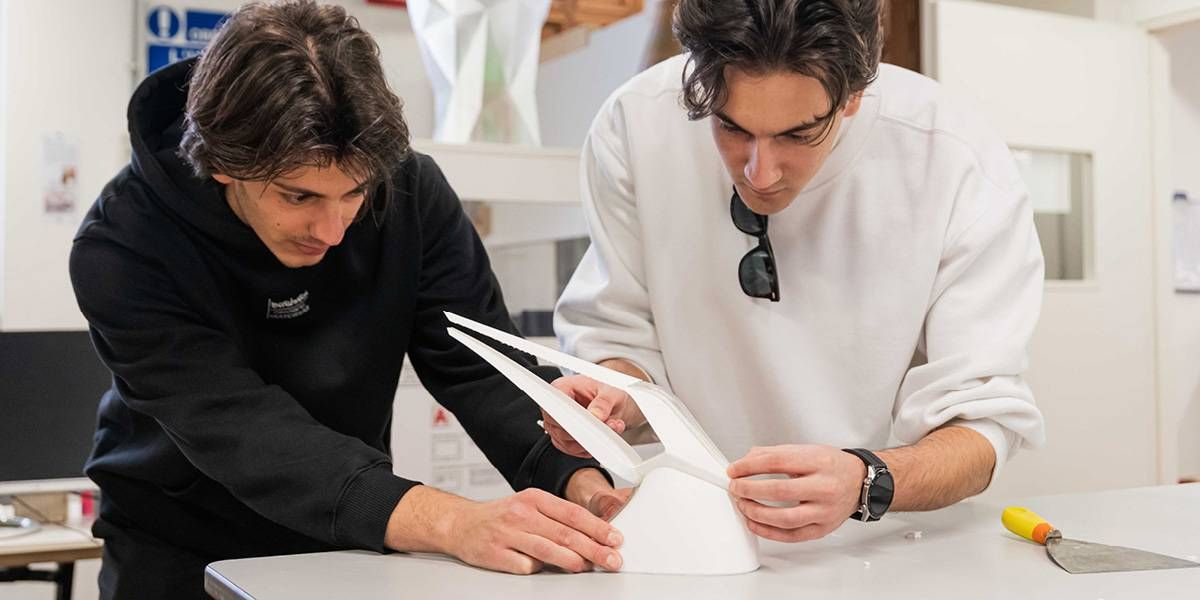
NABA’s Master of Arts programmes award a Second Level Academic Degree, recognised by MUR within the AFAM system, and place design practice at the centre of the learning experience. Students respond to briefs, conduct research, experiment, take part in project reviews and present their work, engaging with faculty members and industry professionals while developing real projects.
This approach provides an immersive understanding of the design profession. Students engage with professional working methods every day and learn to manage each stage of the process, from analysing the context and defining the idea to developing and communicating the final proposal. This connection between education and professional practice is also reflected in NABA’s employability figures: according to the Ipsos Doxa Employability Survey 2026, 92% of NABA graduates are in employment within one year of completing their studies. In the Design Area, the figure rises to 98%, the highest result among the Areas included in the survey.
FAQ
A Master of Arts in Design normally takes two years and carries 120 CFA, the credit system used by Italian AFAM institutions. It awards a Second Level Academic Degree, the second-cycle AFAM qualification corresponding to a Laurea Magistrale in the university sector.
A Master of Arts in Design can help you enter the job market with a more distinctive specialisation, a more mature portfolio and a more independent design method. It may strengthen your profile when applying to established studios, international teams or projects in which research, strategy and the ability to manage complexity are particularly important.
Applicants are generally expected to hold a Bachelor of Arts, a First Level Academic Degree or an equivalent international first-cycle qualification in a field related to the chosen programme. Design skills, a portfolio and proof of language proficiency may also be required. Criteria vary by specialisation, so consult the entry requirements for NABA postgraduate programmes to check whether your previous studies are suitable.
A Master of Arts is a two-year second-cycle programme within the AFAM system and awards a Second Level Academic Degree. An Academic Master normally lasts one year, carries at least 60 CFA and leads to a First Level Academic Master Degree, focusing on more targeted professional expertise. The two qualifications are different and serve distinct educational purposes.
Consider the area in which you want to develop your design practice and the kinds of projects you hope to undertake. Interior Design is appropriate if you want to focus on spaces and the experience of those who use them; Product and Service Design if you want to develop products, services and systems; and Social Design if you want to work with communities and places or contribute to social and environmental transformation. Comparing curricula, student projects and the skills developed by each programme will help you identify the pathway that best matches your goals.
Thinking about studying Design at NABA? Find the right programme for you
Speak with one of our advisors to explore NABA’s Design programmes and identify the pathway that best matches your interests and goals.