


- AFAM and university: what really changes
- Studying design at an Academy or university: how the method changes
- Career opportunities: what happens after studying at an Academy or university
- How to choose the right pathway: design at an Academy or university?
- Studying design at NABA: the Design Area offer
- Discover why you should study Design at NABA
Choosing where to study design means deciding what kind of educational pathway can turn a creative interest into professional expertise. For many students, the question begins precisely here: is it better to enrol at an Academy of Fine Arts or choose a university course in design? The answer depends not only on the qualification you obtain, but on how you want to learn, design and build your profile over time.
In Italy, design can be studied both within the university system and within the AFAM system (Alta Formazione Artistica, Musicale e Coreutica), which also includes Academies of Fine Arts. Both are recognised areas of higher education, but they are built on different approaches: the relationship between theory and practice, the role of projects and the way students develop skills, a portfolio and a professional vision all change.
The question, then, is not which system is better in absolute terms, but which one is more consistent with the way you learn and with the sector you hope to enter. Some students need a project-based, immersive and workshop-led pathway; others prefer a more theoretical, methodological or interdisciplinary education. In both cases, the question to address is practical: what kind of designer do you want to become?
Today’s market looks for well-rounded profiles. Aesthetic sensitivity and creativity are not enough: designers also need method, visual culture, research skills, command of digital tools, an aptitude for teamwork and an awareness of social, technological and production-related change. This is why the comparison between an Academy and a university should focus on the actual quality of the pathway: curricula, laboratories, faculty, collaborations with companies, international opportunities, the chance to take part in real projects and connections with the professional world.
AFAM and university: what really changes
Students who want to study design in Italy can choose between university pathways and AFAM pathways. Academies of Fine Arts belong to this second system: they are higher education institutions recognised by the Italian Ministry of University and Research, dedicated specifically to artistic, design and creative disciplines. They are not, therefore, a less institutional route than university, but a different system, created to train professionals in fields where research, visual culture, technical knowledge and design practice develop together.
AFAM qualifications also have official value and are equivalent to university degrees. Recognised Academies can offer three-year programmes awarding First Level Academic Diplomas, two-year specialist programmes awarding Second Level Academic Diplomas, as well as Academic Masters and advanced training pathways. This structure makes it possible to build a progressive educational journey, from foundational training to specialisation, with qualifications valid for entering the job market, continuing studies and, where applicable, public-sector selection procedures.
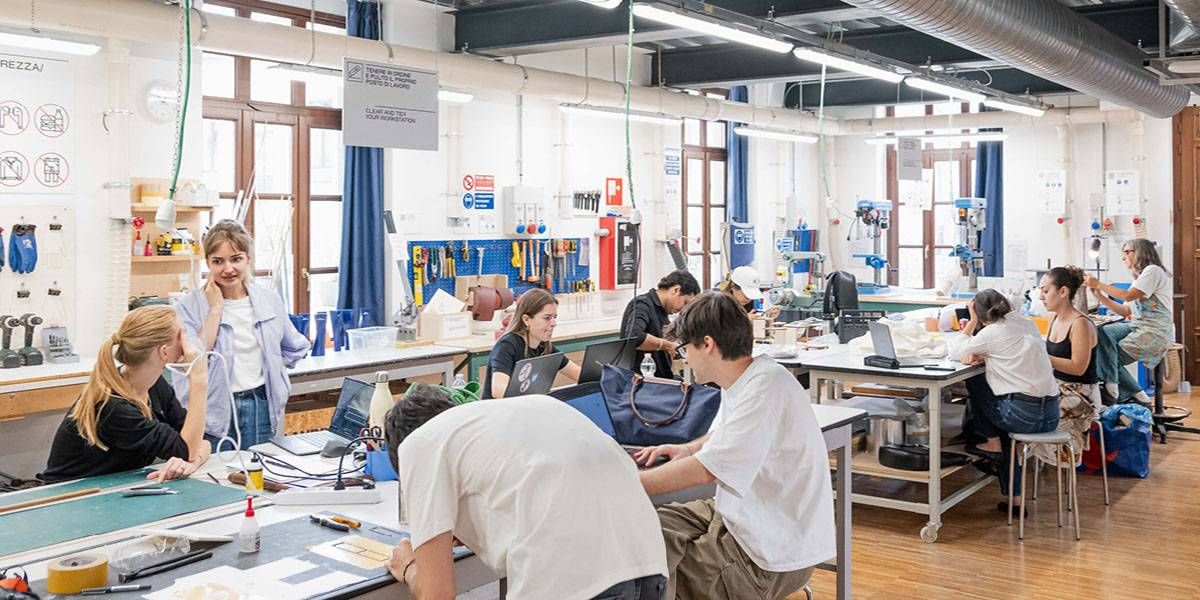
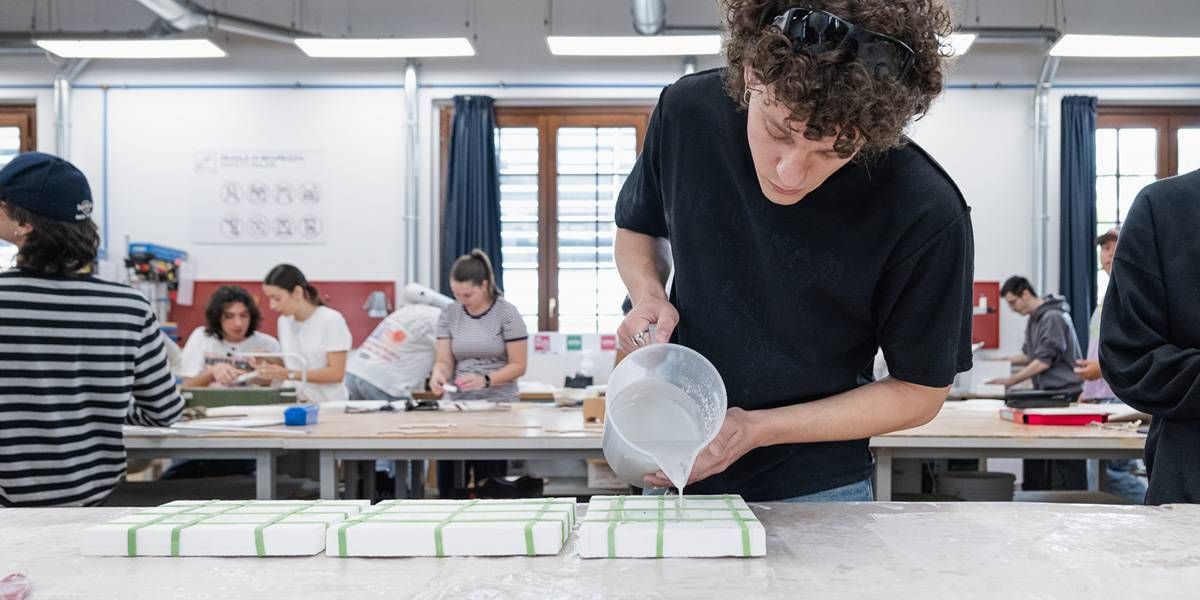
The real difference lies not in the validity of the qualification, but in the educational approach. A university course in design may place greater emphasis on a theoretical, methodological, historical or interdisciplinary approach, often within departments that engage with engineering, architecture or the social sciences. An Academy of Fine Arts tends instead to work more directly through design practice: workshops, briefs, critiques, experimentation, prototypes, presentations and portfolio development become an integral part of the learning experience. For those who want to emerge in the creative professions, this approach can be particularly effective, because it helps turn ideas, references and visual sensitivity into concrete projects that can also be read by the market.
Studying design at an Academy or university: how the method changes
Beyond the qualifications awarded, it is essential to look carefully at how design is studied. The difference between an Academy and a university is most visible in students’ day-to-day experience: how they work on projects, how much space is given to laboratories, what role critiques play, how theory and practice interact and how effectively the pathway helps students build an initial professional identity.
In university design courses, education may give considerable space to theoretical analysis, design history, research, methodology and connections with disciplines such as technology, economics, architecture or the social sciences. This approach is useful for understanding design as a complex system, connected to innovation, production processes, human behaviour and cultural change.
At an Academy, by contrast, design is more often approached as design practice. Students work on briefs, assignments, critiques, prototypes and presentations that require visual, technical and conceptual decisions. Theory is not separated from making; rather, it becomes a tool for reading a context, building an idea, justifying a choice, developing a language and arriving at a concrete outcome.
This approach is particularly relevant for those who want to enter the creative professions, because it allows them to train skills assessed directly by the market: the ability to interpret a brief, develop a proposal and articulate the design process, collaborate with other professional profiles involved and present the final idea clearly. An Academy pathway therefore produces not only knowledge, but also materials, experiences and projects that gradually feed into a personal portfolio.
Attention to method is not a secondary detail: it determines how students learn to think, design and communicate. A more theoretical pathway may suit those looking for an education oriented towards research and systems analysis; a workshop-based pathway may be more effective for those who want to engage immediately with design practice and with the concrete construction of their own creative language.
Career opportunities: what happens after studying at an Academy or university
Another aspect to consider when choosing between an Academy of Fine Arts and a university is career opportunities. The world of design is now extremely varied: it includes established fields such as Product and Service Design, Interior and Living Design, but also fast-growing areas such as Italian Design, Sustainable Design, Social Design and design for innovation.
Students from a university pathway may find opportunities in roles that require a strong methodological and research-based foundation: research centres, strategic planning departments and sectors requiring cross-disciplinary expertise across design, engineering and management. This profile often works on processes, the analysis of design data and the definition of future scenarios.
Those who graduate from an Academy of Fine Arts, on the other hand, often move more quickly into operational contexts: design studios, consultancies, companies in the fashion, luxury and furniture sectors, institutions and similar environments. Continuous project work, critique practice and attention to formal quality produce profiles ready to engage with creative directors and clients, capable of translating a need rapidly into a design proposal.
In both cases, what makes the difference when entering the job market is the portfolio. More than the final mark or the name of the institution, it is the projects completed that speak on behalf of the student. A pathway that gives real space to laboratory work and the critical review of projects enables students to build this tool during their studies, presenting the market with a competent, recognisable profile aligned with a personal design identity.
How to choose the right pathway: design at an Academy or university?
To choose between an Academy and a university, it is useful to consider a number of specific criteria. The first is curriculum analysis: it is worth reading the individual course descriptions carefully, understanding how many hours are dedicated to practical laboratory work, which software and tools are used, what kinds of projects students are asked to complete and how often critiques and interim presentations take place.
A second criterion is the faculty. In the best universities and design Academies, teaching is largely entrusted to active professionals: designers, art directors, planners, researchers and established entrepreneurs in the sector. This ensures direct contact with current languages, methodologies and trends, as well as a network of relationships that can facilitate internships, collaborations and job opportunities at the end of the programme.
The international dimension of the academic offer also matters. The opportunity to study with lecturers and students from different contexts, to take part in workshops with international organisations, to experience exchanges or to follow entire courses in English broadens cultural perspective and prepares students to work in global teams, in a sector that is by nature not limited by geographical boundaries.
It is also important to assess the collaborations with companies, brands, cultural institutions and festivals offered during the course of study. Projects developed with real partners allow students to engage with concrete constraints, refine their ability to work in teams and gain experiences that can be documented in their portfolio. Taken together, these elements help build a solid and competitive profile.
Finally, it can be useful to attend Open Days, speak with students and alumni, observe the study spaces, laboratories, classrooms and exhibition areas, and gain a clearer sense of the environment in which you will study.
Studying design at NABA: the Design Area offer
NABA, Nuova Accademia di Belle Arti is an Academy legally recognised by the MUR, awarding qualifications equivalent to university degrees, and is currently, according to the QS World University Rankings by Subject, the first Italian Academy of Fine Arts in the global Top 50 for Art & Design. Within the Design Area, NABA offers, across its Milan, Rome and London campuses, an academic offer designed to accompany design students throughout their journey, from foundational education to advanced specialisation, combining theory, workshops and projects developed with internationally renowned companies, professionals and brands.
The courses offered by NABA’s Design Area are:
- BA in Design: the ideal starting point for those who want to learn how to observe the contemporary world, develop design sensitivity and master the tools of the profession. From the second year, students can choose between specialisations in Interior Design, Product Design and Product and Innovation Design.
- MA in Interior Design: dedicated to the design of public and private spaces and to new ways of living, inhabiting and working within a global context.
- MA in Product and Service Design: trains designers capable of managing the entire life cycle of a product, from ideation to prototyping, integrating environmental sustainability and service logic.
- MA in Social Design: a unique pathway in Italy focused on social development strategies, the enhancement of human and natural resources and sustainable innovation.
- Academic Master in Italian Design: an intensive research and design journey exploring the distinctive features of Italian design and its international projection.
- Academic Master in Interior and Living Design: immerses students in the universe of contemporary living and the study of spaces for a constantly evolving society.
A complete offer, designed to train designers ready to interpret the complexity of the present and imagine the future of design.
Discover why you should study Design at NABA
Speak with an advisor to find out more about the courses in the Design Area and identify the pathway best suited to your goals.