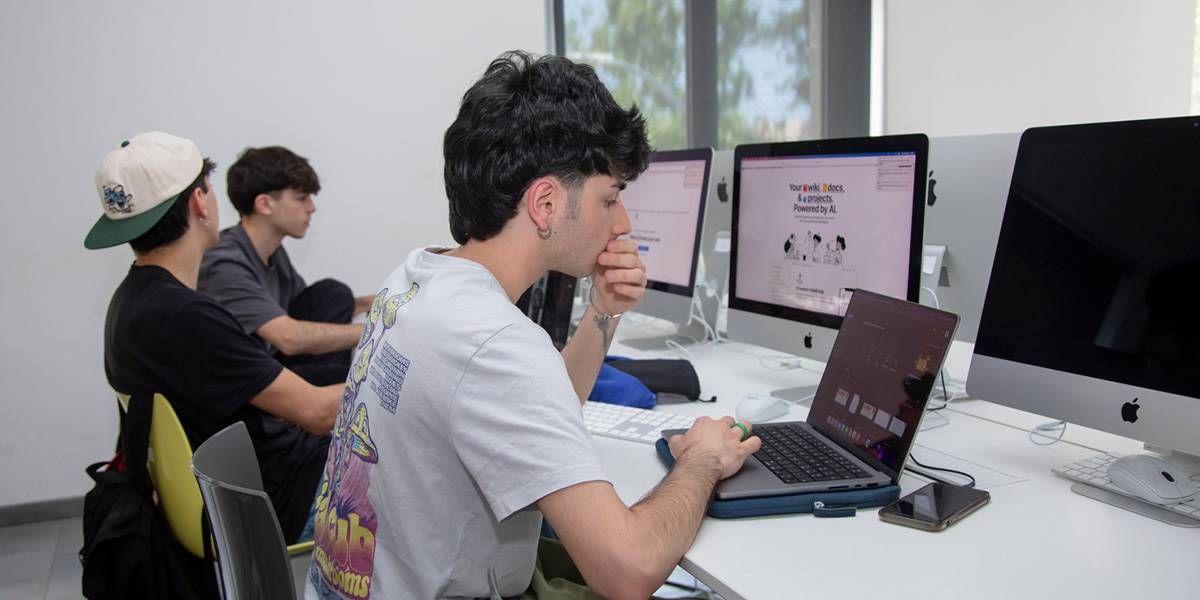
On 25 March, the NABA Rome campus was the subject of a report on the relationship between Artificial Intelligence and creativity, broadcast on Rai 3 as part of the programme "Quante storie".
The report followed the first-hand experience of three students, alongside the contribution of Antonella Salvatore, School Director of the Rome campus, offering a thoughtful look at a topic of growing relevance today - particularly within design processes.
AI, education and responsibility: the views of Antonella Salvatore and NABA students on "Quante storie"
During the programme, Antonella Salvatore pointed out that the topic of Artificial Intelligence cannot be approached from a purely technical standpoint but calls for a mindful educational approach. The aim is not only to teach students how to use it, but also to help them develop the ability to critically assess its impact, understanding when and how to bring it into the creative process in a responsible and independent way.
The programme then turned to the experiences of three students from different fields of study, each with their own approach to the use of Artificial Intelligence.
Francesco Bagnati, a student on the BA in Film and Animation, spoke about his project "Building a Father" (2025), a short film made in collaboration with NABA and AAMOD. Drawing on a personal exploration of his father, who passed away when he was a child, he used archival footage processed through machine learning to reconstruct his identity. The process exposed the shortcomings of the tool: on several occasions, the AI produced images that did not match his memories, highlighting the risk of distorting reality.
Angelica Ferrara, a student on the BA in Graphic Design and Art Direction, discussed the use of Artificial Intelligence linked to the exploratory phase of a project. Using AI, she generated a series of posters designed to speak to one another, taking them as a starting point to develop a communication project. Her contribution, however, points to an essential issue: automated generation alone is not enough to build a fully formed visual identity. It is the human work that follows - selection, interpretation and creative direction - that turns the AI output into a project with meaning.
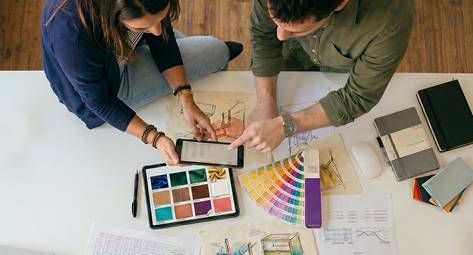
Finally, Luca Persia, a student on the MA in Product and Innovation Design, described a targeted use of Artificial Intelligence in the early stages of a project. It can be used to quickly produce an initial representation of an idea - such as preliminary renders or reference images - helpful in guiding the design process. His contribution, however, makes one clear limitation apparent: the tool speeds up the visualisation phase, but it replaces neither technical skills nor the use of professional software. AI therefore remains a working aid, limited to the early stage of the creative process.
Watch the full report broadcast on Rai 3: watch the video