

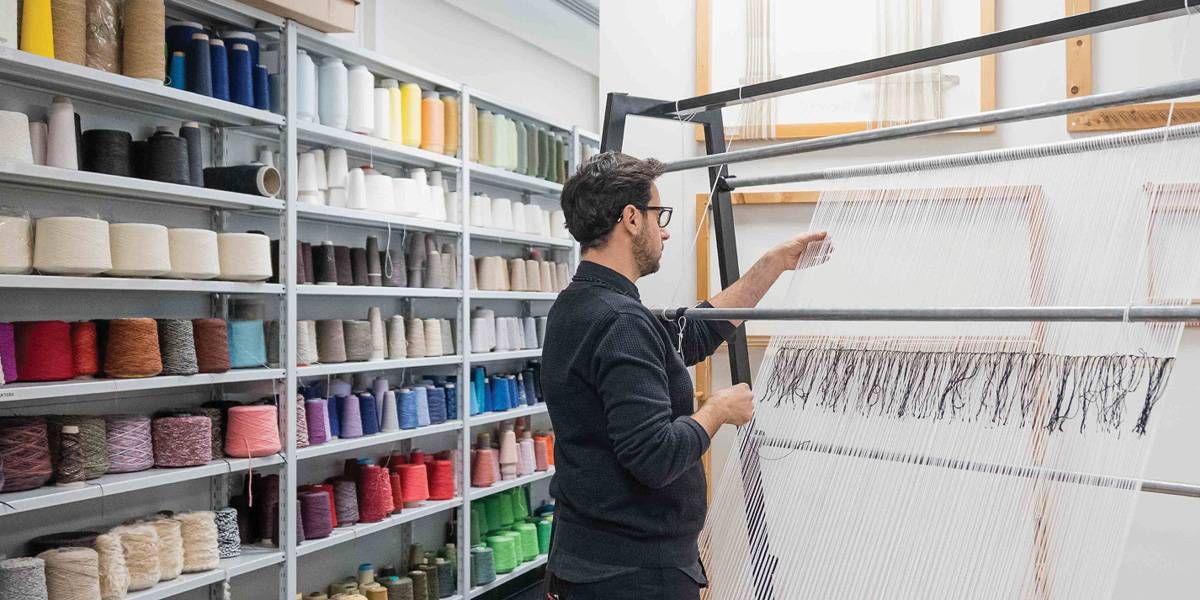
- Fashion Design course: the most common expectations
- What do you really study in a Fashion Design course? The four pillars
- Fashion courses: which Fashion programmes does NABA offer?
- What do you study in NABA’s Fashion Design courses?
- Learning by doing: fashion comes to life in NABA’s labs
- How to understand whether a Fashion course is right for you
- Discover the Fashion Design course that best suits you
In a Fashion Design course, students study pattern cutting, materials, the production supply chain and the fashion system: four areas that turn a creative idea into a real, marketable product.
Studying Fashion Design, therefore, does not simply mean drawing clothes or following a moment of inspiration. It means understanding in detail how a garment is actually constructed and presented to the market: from pattern cutting to fabric selection and production processes, through to the most common dynamics of the fashion industry.
Not only theory, but above all practical work, experimentation and constant development — because all the skills needed to stand out in the fashion industry are built day by day, lesson by lesson, by choosing the course that best fits your needs.
Fashion Design course: the most common expectations
When thinking about a Fashion Design course, it is easy to imagine days spent drawing outfits non-stop, moving from one source of inspiration to another in a continuous flow of ideas and creative influences. And that is all true… but there is much more to it.
When it comes to studying fashion, somewhat romanticised expectations are common. In fact, they are almost a classic. These are the most frequent ones:
- “If you can draw, you are already halfway there”: being able to draw is a good starting point, but it is not enough. A fashion illustration can be beautiful, but if you do not know how to turn it into a correctly constructed garment, with the right proportions, real fit and suitable materials, it remains only an idea on paper;
- “Fashion is all flair and personal taste”: taste matters, but it is not enough to build fashion collections that genuinely work. To stand out, you need method, consistency, knowledge of the target market and the ability to develop a strong concept and carry it through in a structured way;
- “Technique is learnt at work, not while studying”: the technical details linked to pattern cutting, knowledge of materials and production processes cannot be improvised. They are developed during your studies, both theoretically and — above all — through practical lab work, as happens in NABA’s Fashion Labs, where theory becomes everyday practice.
- “The market is someone else’s concern”: all designers need to understand precisely who they are creating for, the current market dynamics and the trends shaping the sector. Target, price, positioning and brand identity are essential elements for designing collections that leave a mark.
Going beyond clichés means understanding what you really study when choosing a BA, a Master of Arts or an Academic Master in fashion — whether in Fashion Design, Textile Design, Fashion Marketing Management, Fashion Digital Marketing, Fashion Management, Fashion Design or Fashion and Costume Design.
What do you really study in a Fashion Design course? The four pillars
Students on a Fashion Design course follow a structured pathway that teaches them how to design in a complete way: from the initial idea to the correct construction of the garment.
The training offered by the best fashion courses is built around four fundamental, interconnected pillars:
- Design and pattern cutting;
- Materials and textiles;
- Supply chain and production;
- Market and fashion system.
Fashion course – Design and pattern cutting: how a fashion collection is created
First of all, in a Fashion Design course students learn how to create a garment in concrete terms, turning an idea into a real product by working on shape, structure and fit:
- From fashion illustration to pattern: the process begins with sketching and moves on to the technical construction of the garment — developing the pattern, studying proportions, defining volumes and lines. Students therefore learn how to establish a precise construction base;
- Digital pattern cutting and 3D software: students become familiar with tools such as CLO3D, which make it possible to simulate a garment digitally before physical prototyping, reducing waste and speeding up the creative process;
- Prototyping and fitting: the garment is produced as a prototype and tested to assess fit, balance and functionality. Any issues are analysed and addressed through targeted adjustments;
- Construction and finishing: students explore sewing, assembly and finishing techniques. Precision, cleanliness and attention to detail affect both the appearance and the durability of the garment.
This is where students acquire the technical foundations needed to build a strong collection, not only creatively but also structurally.
Fashion course – Materials and textiles: choosing with awareness
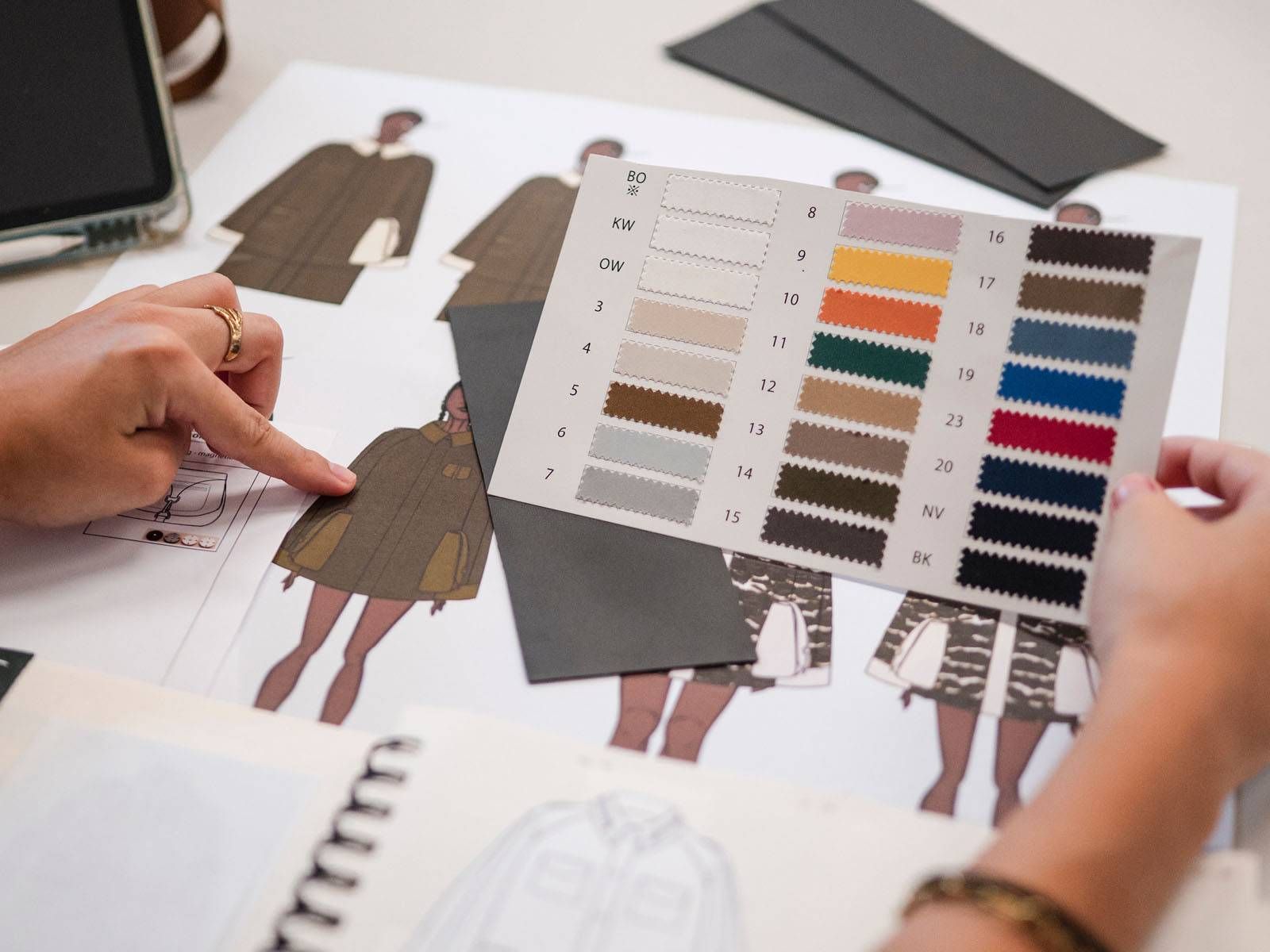
The study of materials is essential in a Fashion Design course. The focus is not only on appearance, but above all on the technical characteristics of the fabric and the way these affect the final result. In particular, students focus on:
- Fibres and compositions: students learn to recognise natural, synthetic and blended fibres in order to understand their properties, behaviour, resistance and care requirements. Composition affects comfort, durability and garment quality;
- Structure, drape and fabric performance: students examine the aspects that directly influence the final appearance of a garment or accessory — such as weave, weight, elasticity, drape and texture — as well as performance and functional characteristics, including breathability, insulation and waterproofing;
- Colour and treatments: students become familiar with colour theory, dyeing techniques, prints and finishing processes, all of which give identity to a collection;
- Sustainability and sourcing: students analyse the origin, production processes and environmental impact of each material, in order to design more consciously and responsibly. This includes sustainable textiles and innovative materials, such as bio-based fibres, recycled materials, high-performance technical fabrics and leather alternatives.
Fashion course – Supply chain and production: how the production of a collection really works
For those studying Fashion Design, the supply chain is not a secondary detail: it is the difference between a collection that exists only on paper and one that actually reaches the market. Designing also means knowing how a garment will be made — understanding every step that leads from the sketch to the prototype and through to final production, so that garments can be effectively produced and costly design errors avoided.
Fashion students need to examine every stage of the production process:
- Technical development of the garment: drafting detailed technical sheets, with measurements, construction specifications and precise instructions for those who will make the garment in production;
- Production processes: cutting, construction, quality control and industrialisation of the model — in other words, how to turn a one-off prototype into a garment that can be reproduced in series;
- Timings, costs and suppliers: production planning, quantity management, assessment of economic feasibility and selection of production partners;
- Quality control and standards: checking fit, finishes and compliance of the final product with the initial specifications.
Fashion course – Market and fashion system: designing for a real audience
Creating a successful fashion collection does not simply mean having a strong idea — it means understanding who it is being created for, who the target audience is, where it will be sold and how it will be perceived. The fashion market is made up of distinct segments, each with its own rules, languages and dynamics. A good Fashion Design course teaches students to design collections effectively, so that they make sense not only aesthetically but also commercially.
The themes addressed in this area include:
- Brand identity and positioning: defining the identity of a brand and its target audience. Every choice — from style to materials, through to price — must be consistent with the target and with the brand’s values;
- Distribution channels and launch strategy: physical retail, e-commerce, wholesale, direct-to-consumer. The chosen channel affects the type of product, the expected quality level and the communication strategy. Today, social media — especially Instagram and TikTok — are also launch channels in their own right, capable of building or damaging the perception of a brand in just a few hours;
- Digital brand identity: in the current context, a brand’s identity is built online as much as offline. Knowing how to design a collection while considering how it will be communicated across digital channels has become an essential skill for anyone working in fashion;
- Trends and culture: analysing trends and cultural movements, and interpreting them with method and awareness, helps students develop proposals that are coherent, recognisable and commercially sustainable.
Fashion courses: which Fashion programmes does NABA offer?
For those who wish to study Fashion Design in Milan, Rome and London, NABA, Nuova Accademia di Belle Arti, offers one of the most extensive academic portfolios in fashion. Its programmes cover the full academic pathway: from first access to advanced specialisation.
Here is an overview of all Fashion programmes offered by NABA and the Academy campuses where they are available:
| Programme | Level | Campus |
|---|---|---|
| Fashion Design | BA (First Level Academic Degree) | Milan, Rome, London |
| Fashion Marketing Management | BA (First Level Academic Degree) | Milan, Rome, London |
| Master of Arts in Fashion Design | Master of Arts (Second Level Academic Degree) | Milan |
| Master of Arts in Textile Design | Master of Arts (Second Level Academic Degree) | Milan |
| Master of Arts in Fashion and Costume Design | Master of Arts (Second Level Academic Degree) | Rome |
| Academic Master in Fashion Digital Marketing | Academic Master (First Level) | Milan + Hybrid Part-Time* |
| Academic Master in Fashion Management | Academic Master (First Level) | Milan |
| Academic Master in Fashion Design | Academic Master (First Level) | Milan |
| Academic Master in Sneaker Design | Academic Master (First Level) | Milan |
*Possibility of remote evening classes during the week and one weekend per month on campus, offering a flexible way to combine study and work.
BA programmes (First Level Academic Degree):
- Fashion Design — the core pathway for those who want to become fashion designers. It combines design, pattern cutting, material culture and the fashion system in a practical, interdisciplinary programme, with continuous lab work and collaborations with companies in the sector;
- Fashion Marketing Management — for those who want to work at the intersection of creativity and strategy: brand identity, supply chain, digital marketing and distribution in the contemporary fashion system.
Master of Arts programmes (Second Level Academic Degree):
- Master of Arts in Fashion Design — an advanced pathway focused on research, prototyping and the development of a personal design vision, with a strong laboratory component;
- Master of Arts in Textile Design — dedicated to textile design, material culture and experimentation on surfaces;
- Master of Arts in Fashion and Costume Design — for those who want to work at the crossroads of fashion, garment construction and narrative, with particular attention to costume for performance and archival methodologies.
Academic Masters (First Level):
- Academic Master in Fashion Digital Marketing — designed to train professionals in marketing and digital communication for the fashion and lifestyle sectors. Also available in hybrid part-time mode;
- Academic Master in Fashion Management — dedicated to those who wish to develop advanced skills in the strategic management of the fashion system, from branding to product management, from merchandising to retail and communication;
- Academic Master in Fashion Design — designed to explore contemporary fashion design through research, product development, experimentation and new design methodologies;
- Academic Master in Sneaker Design — dedicated to the design and development of streetwear footwear.
What do you study in NABA’s Fashion Design courses?
Those who decide to study Fashion Design at NABA do not follow a linear pathway made up only of theoretical subjects, but an integrated learning system in which design, technical and cultural disciplines are interwoven from the first year. The main subjects are organised around three fundamental axes — design, technical, and critical-cultural:
- Design axis — from research to collection: the core of the programme is fashion design, which begins with visual and conceptual research, develops the collection concept and leads to garment construction through technical drawing, pattern making and prototyping. The second year of the Master of Arts programmes, in particular, is structured around the creation of a complete collection that demonstrates the student’s ability to manage the entire process independently.
- Technical axis — actually constructing a garment: the technical component runs across all levels. In the BA programme, students acquire the construction foundations; in the Master of Arts and Academic Masters, they explore technical complexity in greater depth through a more experimental and personal approach.
- Critical-cultural axis — understanding context: NABA courses include subjects such as History of Art and Costume, Semiotics, Cultural Anthropology, Media Phenomenology and Marketing because the aim is not only to train technicians, but professionals capable of reading the present and translating it into a visual language that can also engage the market.
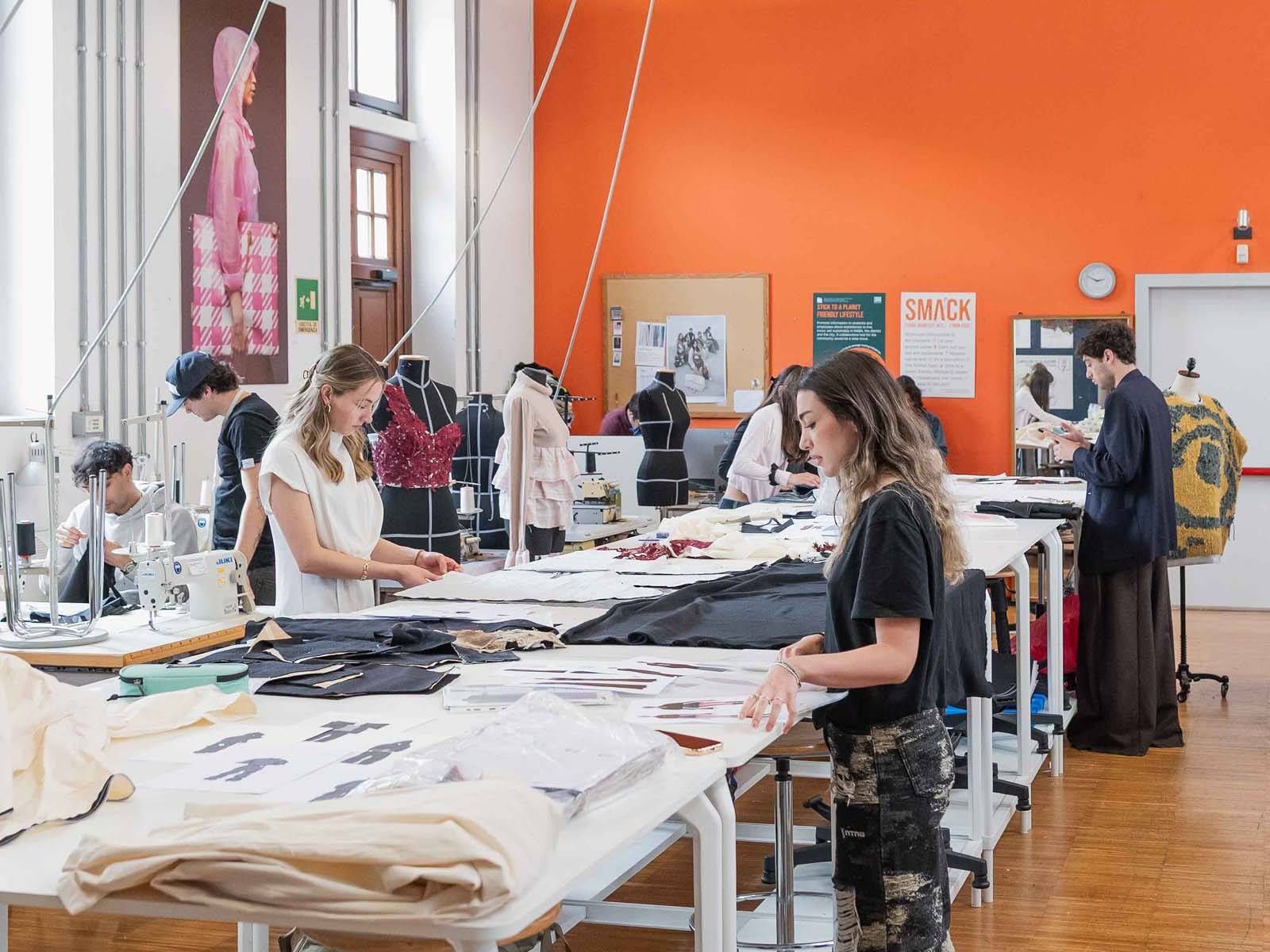
Learning by doing: at NABA, fashion does not remain theoretical but comes to life in the labs
Studying Fashion Design at NABA means turning theory into practice from the very beginning, thanks to the Academy’s fully equipped laboratories. Those dedicated to the Fashion Design Area cover all areas of fashion production:
- Sewing Lab: industrial sewing machines, presses, irons and professional stands, as well as men’s, women’s and children’s mannequins;
- Textile Lab: equipped for direct experimentation with fabric dyeing and printing;
- Knitwear Lab and Textile Archive: around 4,000 catalogued samples with technical sheets, enabling students to understand materials physically, not only theoretically;
- Advanced technologies: Lectra System, Framis machine and Shima Seiki — machinery used by the fashion industry internationally.
Working with these tools during your studies means entering the professional world with concrete, immediately applicable technical preparation.
How to understand whether a Fashion course is right for you
How can you understand whether a Fashion Design course is right for you? The first question to ask yourself is: “Do I want my future to be in fashion?”. If the answer is yes, the next step is to understand which educational pathway best matches your interests, your level of preparation and the professional goals you want to achieve.
Some questions can help you clarify your direction:
- Are you passionate about designing collections and constructing garments? Working with materials, understanding how a garment is created and developing your own design identity: if this is what you are looking for, a pathway in Fashion Design is the ideal starting point;
- Are you interested in the strategic side of the fashion system? If branding, marketing, communication and product management fascinate you, you may choose pathways such as Fashion Marketing Management, Fashion Digital Marketing or Fashion Management, depending on the level of specialisation you wish to achieve;
- Do you already have a university or academic background? BA programmes are designed to build skills from the ground up. Master of Arts programmes and Academic Masters, instead, allow students to explore a specific area in greater depth or acquire advanced skills for entry into the professional world.
There are different pathways for different goals, especially if you choose to study at NABA:
| You are interested in… | The right pathway is… |
|---|---|
| Designing garments, working with materials and developing your own stylistic identity | Fashion Design |
| Communication, marketing and brand strategy | Fashion Marketing Management |
| Exploring fashion design at an advanced level, with a strong focus on research and experimentation | Master of Arts in Fashion Design |
| Exploring textile design and experimentation with materials | Master of Arts in Textile Design |
| Working at the crossroads of fashion, costume, historical research and narrative | Master of Arts in Fashion and Costume Design |
| Digital marketing, communication and digital strategies for fashion and lifestyle brands | Academic Master in Fashion Digital Marketing |
| Strategic management of the fashion system, from branding to merchandising, from product management to retail | Academic Master in Fashion Management |
| Rethinking contemporary fashion design through research, product development and experimentation | Academic Master in Fashion Design |
| Designing and developing streetwear footwear | Academic Master in Sneaker Design |
Discover the Fashion Design course that best suits you
Speak to one of our advisors to learn more about the courses in the Fashion Design Area and identify the pathway best suited to your goals.